Citynet, a regional ISP in Austria
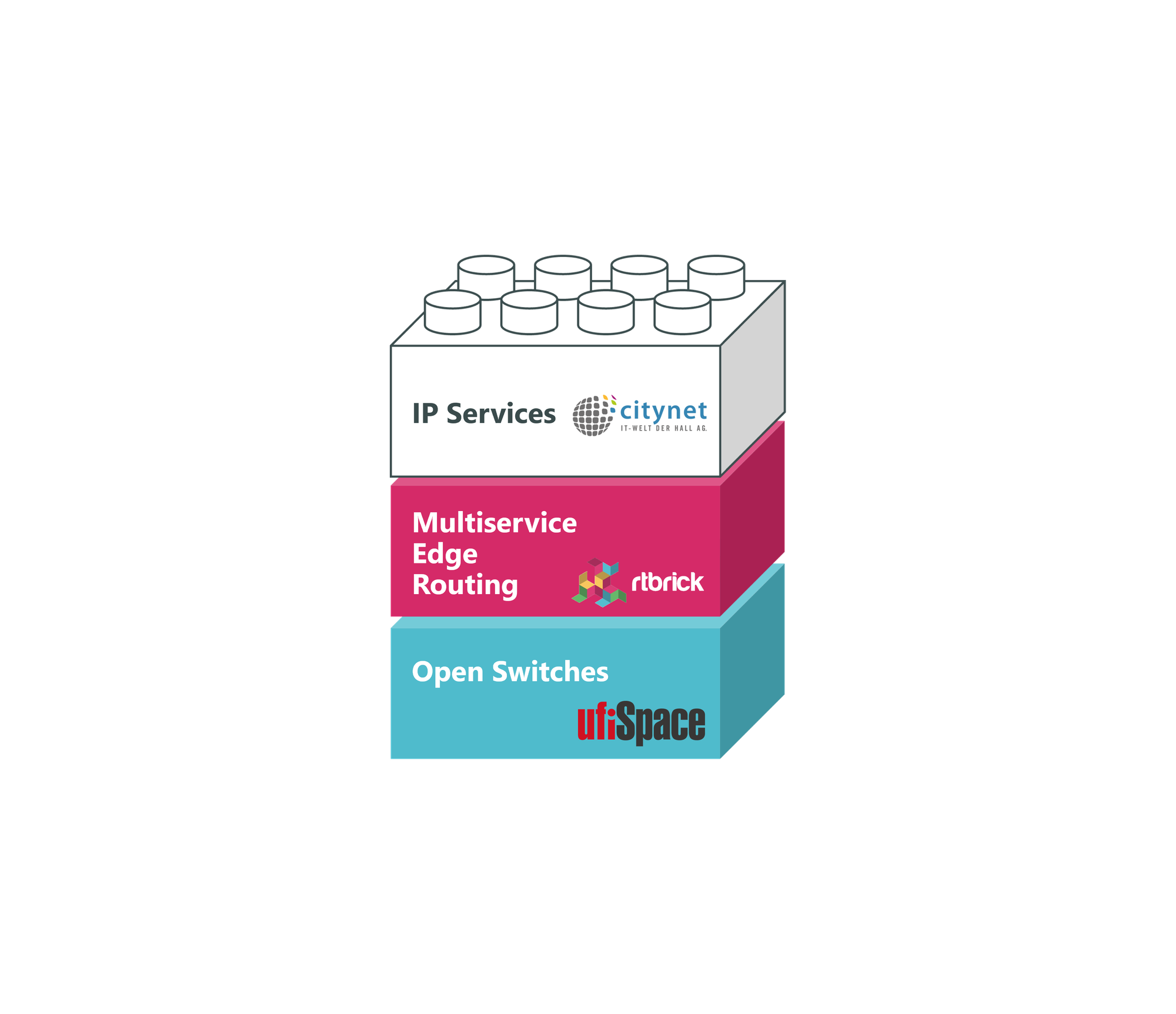
Find out how Citynet, a regional ISP, disaggregated both their core and edge to deliver hyperfast 10Gbps broadband services.
Greater Scale | Lower Costs | Flexibility |
Citynet has no more bandwidth issues. Downstream capacity limitations for its customers have increased to more than 2.5Gbps. And it is easy and cost-effective to add more capacity by adding incremental hardware and granular software licenses. | Disaggregating the entire network has cost significantly less that replacing it with traditional monolithic routing systems, along with reducing power and support costs. | Citynet now has the flexibility to mix and match vendors – choosing one switch vendor in the core, and a different one at the edge, and independently selecting a different NOS at the core and the edge. |
Citynet is a regional Internet Service Provider in Austria. It is the IT brand of Hall AG, a public utility company that provides solar and hydroelectric power, water and other municipal services to the area of Hall in Tirol, near Innsbruck, in the heart of the Austrian Alps.
Download the case study... ...or read more below.
Regional ISP disaggregates core and edge to deliver hyperfast 10Gbps broadband
About Citynet
Citynet is a regional Internet Service Provider in Austria. It is the IT brand of Hall AG, a public utility company that provides solar and hydroelectric power, water and other municipal services to the area of Hall in Tirol, near Innsbruck, in the heart of the Austrian Alps. Citynet has been providing IT services to residential and businesses since 1998 and currently serves 5,500 customers.

Along with network infrastructure, Citynet operates three of its own data centers, in Innsbruck, and Hall, with a third for disaster recovery, as well as having presence in third party data centers in Frankfurt, Milan, Vienna and Zurich.
Matthias Giuliano has been a Senior Network Architect and Engineer at Citynet for ten years and is responsible for their network, as part of a small team of three engineers. “We used to operate a conventional IP network using equipment from an established router vendor,” he explains, “but we’ve always been brave enough to try out new ideas, so when we needed to upgrade our network, we looked for alternative approaches.”
Network Challenges
1. Capacity
Like many ISPs, a steady increase in demand for bandwidth was putting pressure on the capacity of its traditional monolithic routers, and the impact of the Covid pandemic further increased its customers’ expectations from their high-speed connectivity. Citynet found that its 10Gbps interfaces were becoming fully loaded and realized that it needed to upgrade its network to keep pace with customer demand.
2. Costs
Citynet initially looked to its traditional vendors to increase its capacity but couldn’t find reasonably priced hardware. “We also considered alternative options from our existing vendors,” recounted Matthias Giuliano, “but either pricing or vendors’ insistence on subscription licensing models made these unattractive. We needed to add capacity but in a more cost-effective way.”.
3. Platform Flexibility
Citynet also found that many traditional vendor’s platforms were oversized for some of their locations, consuming too much power and leaving them with wasted capacity. “We needed hardware options where one size didn’t have to fit all,” added Giuliano. “We needed scale, but didn’t always need a large chassis-based system.”
A Fully Disaggregated Solution
Citynet realized that disaggregated switching hardware could be a good fit for their requirements, offering them powerful open switches with a small footprint and low power consumption.
“We came across the concept of network disaggregation and started investigating. Initially we bought some open switch hardware from Edgecore and we were impressed by the price and performance,” explains Matthias Giuliano. “The next step was to look at the software options that it could support and we decided to start with the core of our network.”
Citynet used routing software from IP Infusion, running on the Edgecore switches, to replace its core network.
“We tested the hardware and software and swapped out our entire core withing one year of our initial testing, completing the roll-out in 2023,” recalls Matthias Giuliano. “It was a quite a change from our traditional router vendor, with its monolithic hardware and software systems, but the project went smoothly.”
Edge Routing Software
Then Citynet turned its attention to the edge network, which it uses to provide its customer services. It had been using software-based routers and Citynet found they reached the peak throughput of the X86 CPU’s they were running on. Citynet wanted to continue to benefit from a disaggregated approach, and to keep scaling its customer services on high-performance open switches with dedicated networking silicon. The IP Infusion software it uses in the core network didn’t provide broadband protocols such as PPPoE, which are needed to serve residential and small business customers, so it turned to RtBrick to upgrade its edge network.
“We checked out RtBrick’s features and performance and realised we could serve all our customers on a single device, with more than 5,000 dual-stack PPPoE sessions running concurrently and at high speeds. This allowed us to replace 5-6 software routers with a single disaggregated router,” explains Matthias Giuliano.
Open Switching Hardware
RtBrick’s multiservice edge routing software runs on open switches, and is optimized to work on the underlying bare-metal silicon in the open switches, in this case Qumran2C networking chips from Broadcom.
For its edge network, Citynet evaluated open switches from UfiSpace, was impressed by the quality, and selected them as its new edge platform.
“Deploying a different switch vendor for core and edge illustrates the complete flexibility of a disaggregated network,” says Matthias Giuliano. “We can pick the switch that best meets our needs as well as the best routing NOS (Network Operating System) for the job we need it to do.”

Ufispace 9600-72XC Open Switch
Citynet migrated all of its customers onto three UfiSpace 9600-72XC switches, two live and one used as a hot spare and for its lab, building on its earlier core network transition. The UfiSpace 9600-72XC open switches are powered by Broadcom’s Qumran2c networking chips, which enable sophisticated HQoS (Hierarchical Quality of Service) models with four queues per subscriber. Using RtBrick’s routing software, Citynet has transformed these switches into fully functional Broadband Network Gateways (BNGs), delivering premium subscriber services at scale and reduced cost.
Adva optical DWDM systems provide the underlying transport services that interconnect the switches.
OSS
Citynet initially used the RtBrick CLI to configure the network, and extract performance data from the native Prometheus interface that RtBrick provides as part of its software. Prometheus is an open-source time series database. Operational data can then be then visualized, and alerts generated, using Grafana, which is a multi-platform open-source analytics and interactive visualization web application. Since then, Citynet has evolved from using a traditional CLI to a REST-based approach with RtBrick’s open APIs.
“The RtBrick routers were actually the first devices in our network that we chose to manage without using classical SNMP,” said Matthias Giuliano. “We were happy to try it out and it’s worked really well. It’s a really good way to provide streaming telemetry and we realized this is how it should be done – that this is the future. We’re now using RtBrick’s REST API’s for configuration. In fact, we plan to use REST-based APIs for both RtBrick and IP Infusion so we can push new configurations to many devices simultaneously and confirm their success.”
Hyperfast End-User Services
Citynet is delivering PPPoE-based broadband Internet services from the RtBrick edge routers to thousands of customers at speeds ranging from 80Mbps to 10Gbps, with 500Mbps and 1Gbps services becoming more popular, even for residential and small business customers.
Implementation
Citynet purchased both hardware and software from STORDIS, with support provided directly from RtBrick. Stordis is a European value-added distributor, which provides a wide range of products including open switches from Edgecore and UfiSpace.
The entire network, both core and edge, has now been migrated onto a disaggregated architecture and has been live for four months at the time of publishing.
Key Benefits of the RtBrick Disaggregated Solution
Greater Scale
Citynet has no more bandwidth issues. Downstream capacity limitations for its customers have increased to more than 2.5Gbps. And it is easy and cost-effective to add more capacity by adding incremental hardware and granular software licenses.
Lower Costs
Disaggregating the entire network has cost significantly less that replacing it with traditional monolithic routing systems, along with reducing power and support costs.
Flexibility
Citynet now has the flexibility to mix and match vendors – choosing one switch vendor in the core, and a different one at the edge, and independently selecting a different NOS at the core and the edge.
“We love the freedom of choice” says Matthias Giuliano. “We can use the hardware and software we want, without having to stick to one vendor. We can support larger sites with more powerful hardware and scale down to smaller locations on small switches if we need to, but still run the same software and get the same features. This gives us a lot of flexibility to deploy platforms that are the right size for the job we need them to do.”.
Next Steps
Citynet is now migrating its IPTV and VoIP services from its remaining X86-based software routers.
Finally… some advice to others
Matthias Giuliano had this advice for other ISPs considering disaggregating their network.
“We might be the first Austrian ISP to fully disaggregate our network using open hardware and software. It’s turned out to be a very good decision. We have a lot of interest from others who want to hear about what we’ve done, and two more local ISPs have already decided to follow in our footsteps. There are lots of plus points compared to using traditional hardware: the flexibility, cost-benefits, modern operational environment - you can even do native CGNAT on the same switch. I would say ‘just try it’ – you’re going to be excited!”
The same RtBrick’s multiservice edge routing software that has been deployed by Citynet is also transforming the networks of a wide range of operators, from Deutsche Telekom, Europe’s largest telco, to other regional ISPs such as WOBCOM.”
Download the case study