Peering router
- Your choice of hardware
- Cost-effective
- Secure
Over recent years, ‘cloud-native’ service providers have developed ways to build and run massive data centers with a high degree of automation, to reduce operational overheads and deliver levels of service agility beyond traditional carrier infrastructure. RtBrick’s open disaggregated Peering Router brings these same benefits to ISP networks, by using agile methodologies and the same battle-hardened DevOps cloud automation tools that have been adopted by the world’s biggest cloud providers.
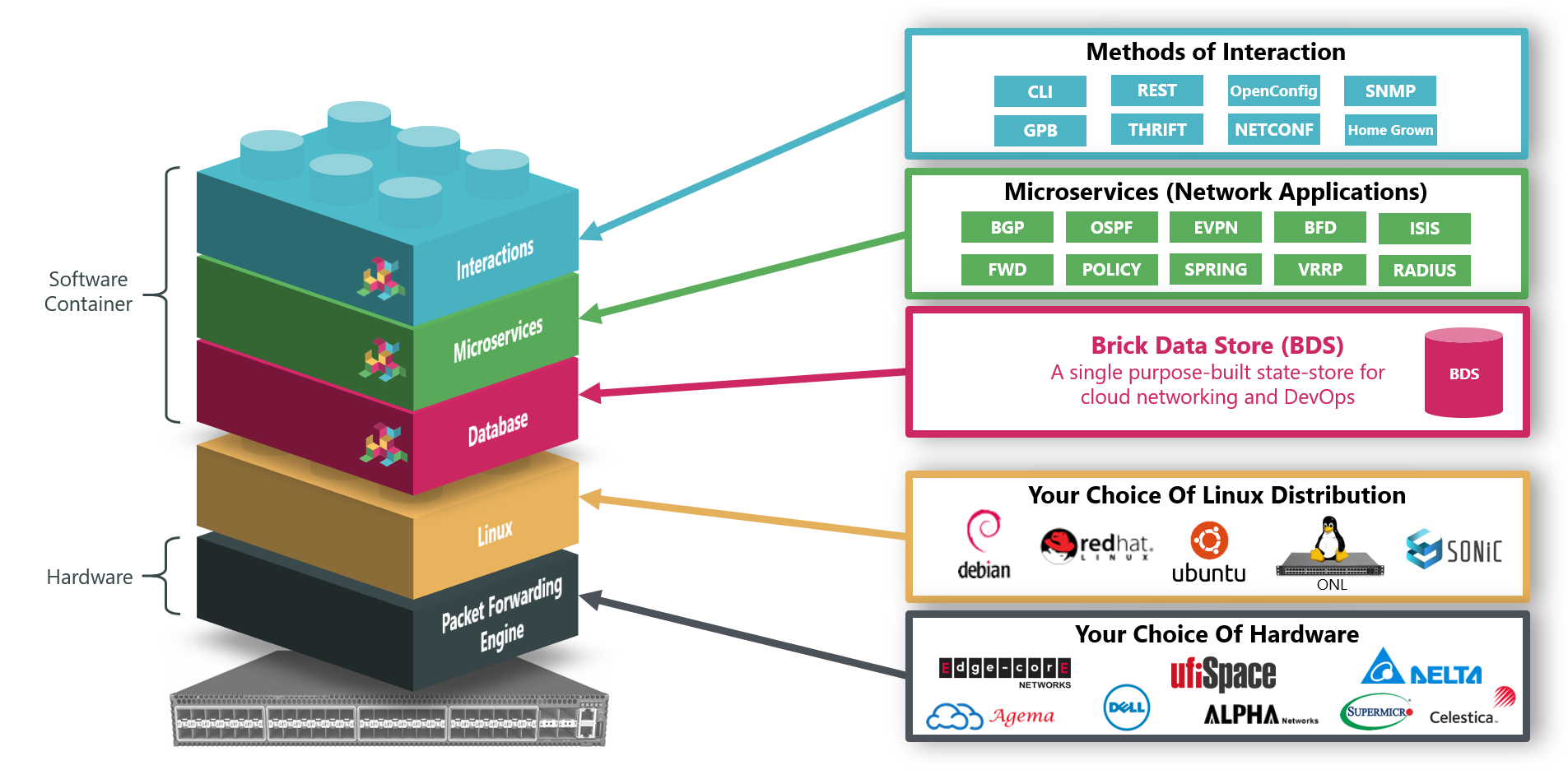
The RtBrick Peering Router is delivered as a software container, packaged out-of-the-box with the Open Network Linux (ONL) provided by the hardware SKU manufacturers, which handles peripherals such as LEDs, temperature sensors, and so on. The RtBrick Peering Router software runs on a choice of low-cost but powerful bare-metal switches.
Benefits
RtBrick’s open BNG software delivers some significant benefits compared to traditional monolithic systems:
Greater Agility
Pick your optimum hardware to deliver the same services from small temperature hardened switches as from large multi-terabit-per-second devices.With ‘cloud-native’ operations you can add capacity, or roll-out new service features, in a matter of minutes instead of days or weeks. The software itself is developed using Agile methodologies so that features are rapidly prototyped and implemented, reducing the time-to-market for new services. Control everything through open APIs, and benefit from our in-built Prometheus time-series-database for telemetry.
Reduced risk
Stateful high availability allows IPoE subscribers to be re-established without them even noticing a failure. And benefit from the world’s fastest routing convergence times. RtBrick’s BNG software has an order of magnitude fewer lines of code than traditional routers, and a single state database rather than hundreds. The whole system is less complex, less prone to bugs and has much faster restart times. It also allows you to pick and mix between the latest silicon and the best available software. By using open switches, you can also diversify your hardware supply chain if you need to.
Lower cost-levels
RtBrick's software runs on powerful but low-cost open switches, with lower power consumed per gigabit than traditional routers.
Deployment Options
The Peering router's capacity can be scaled down to a single RU bare-metal switch or a more powerful 2RU switch with interfaces up to 400Gbps.
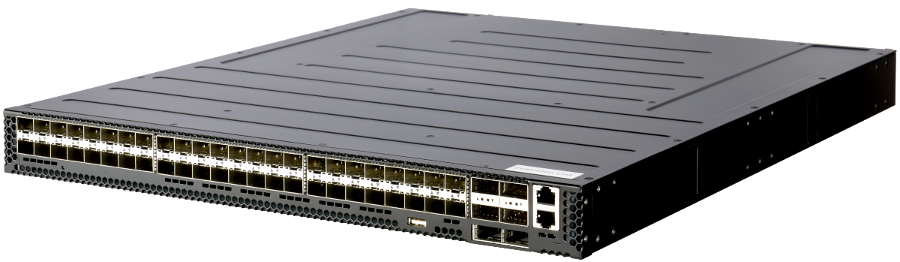
Single RU bare metal switch example
Management and Operations
Along with a traditional CLI, RtBrick’s Management API has been designed to simplify the integration with your existing OSS and BSS systems. It reduces the amount of time and effort required to make your disaggregated network operational, and it leverages widely-adopted industry tools and programming languages. RtBrick’s API is ‘consumer-driven’ – which means you can use the formats and languages of your choice, rather than have them imposed on you by a vendor. This allows you to build a client in Python, Go or Java, for example, as you prefer. And the APIs are all edited in Swagger, which is also a widely understood tool used by developers. RtBrick’s Management API actually comprises of several underlying APIs, which each follow the same consumer-driven approach.
Security
- BGP Flowspec is a powerful tool used to help protect networks from DDoS (Distributed Denial of Service) attacks.
- Resource Public Key Infrastructure (RPKI) is a mechanism that allows network owners to validate and secure the critical route updates, or Border Gateway Protocol (BGP) announcements, and prevent route hijacking or misconfiguration.
- TCP Authentication Option (TCP-AO) enhances the security and authenticity of TCP segments exchanged during BGP and LDP sessions. It adds support for the most current security mechanisms, and is stronger than legacy mechanisms such as TCP MD5.
- sFlow, or "sampled flow", samples packets from routers and sends them to a central collector for analysis, to identify abnormal traffic patterns and potential attacks.
- Generalized TTL Security Mechanism (GTSM) prevents a remote intruder from hijacking a route using a mechanism that also protects it from CPU-utilization based attacks.
Features
The features supported by RtBrick FullStack are expanding all the time, because it's much faster for us to add and test new features than it is using a traditional monolithic code base. You can see our current feature list on our latest data sheet.

Compatible Hardware
RtBrick's Full Stack routing software can operate on many bare metal switches, depending on your performance and port count requirements. You can find details of compatible hardware here.