
Our Multiservice Edge Routing Software
- Feature-rich
- Simpler to automate
- Cost-effective
- Scale up... or scale down
- On your choice of open hardware
Multiservice Edge Solutions
BNG
- Your choice of open switch hardware
- Rich BNG feature set
- Integrated CGNAT
- High availability
- Scale up - or scale down

CGNAT
- Your choice of open hardware
- In-line CGNAT at full line-rate
- Standalone CGNAT or in the BNG
- Rich set of policy support
- Scale up - or scale down

Aggregation
- Your choice of open switch hardware
- Cost-effective
- Automate with open APIs
- Scale up - or scale down
- Part of your disaggregated multiservice edge

Peering
- Your choice of hardware
- Cost-effective
- Feature rich
- Scale up - or scale down
- Peering security
Data Center Interconnect
- Your choice of hardware
- Cost-effective
- Feature rich
- Simpler to automate
- Interconnect like a cloud-native

RtBrick Full Stack (RBFS) is a disaggregated, routing solution engineered to decouple carrier-grade networking functions from proprietary, closed hardware.
Delivered as a high-performance Linux container (LXC) within an Open Network Linux (ONL) environment, RBFS transforms bare-metal switches into modular, highly automated network elements.
By replacing rigid monolithic systems with a microservices-based architecture, RBFS enables a fundamental shift to 'Internet-native' operations, allowing carriers to scale access networks with the agility and cost-structures of global cloud providers.

More Agile
Agile software development, Zero-Touch-Provisioning (ZTP), and rapid feature prototyping. Deployment of new services and capacity in minutes rather than weeks; enables rapid time-to-market

Lower Risk
Elimination of vendor lock-in Reduction in code complexity via a single state database (BDS). Faster system restart times Increased stability through a simplified, automated operating environment
.webp?2026-09-10T13%3A47%3A43.241Z)
Cloud Cost-Levels
Integration with merchant silicon and bare-metal hardware via Web2.0 DevOps tools. Drastic Capex reduction through hardware disaggregation Opex optimization from horizontal scale-out (pay-as-you-grow) and lower power-consumption
System Architecture and Software Stack
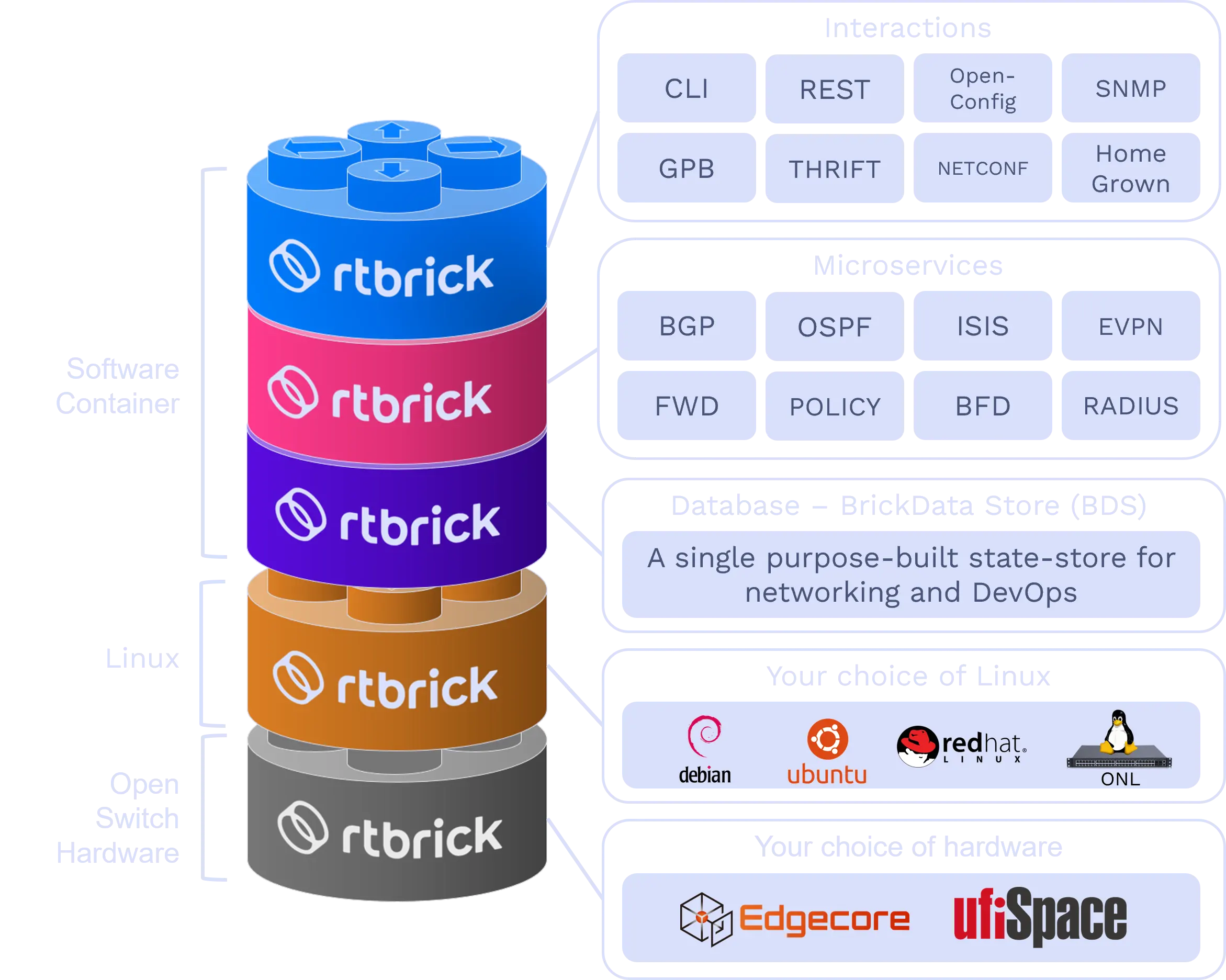
RBFS exports a carrier-grade routing stack through a disaggregated model that isolates the networking software from hardware-specific peripherals.
● Software Container Layer:
Interaction Methods: Supports an industry-standard suite of interfaces including CLI, REST APIs, RESTCONF, NETCONF, OpenConfig, SNMP, and high-performance RPC via GPB (Google Protocol Buffers) and Thrift.
Microservices: Network applications (BGP, OSPF, ISIS, BFD, RADIUS, VRRP, SPRING) run as independent, containerized processes in userspace.
● Database Layer:
Brick Data Store (BDS): A purpose-built, in-memory state-store designed for the massive scale and performance requirements of cloud networking.
● Base OS:
The RBFS LXC container is based on Debian, which manages hardware peripherals (LEDs, temperature sensors) while the networking stack handles packet forwarding in user-space.
High Availability
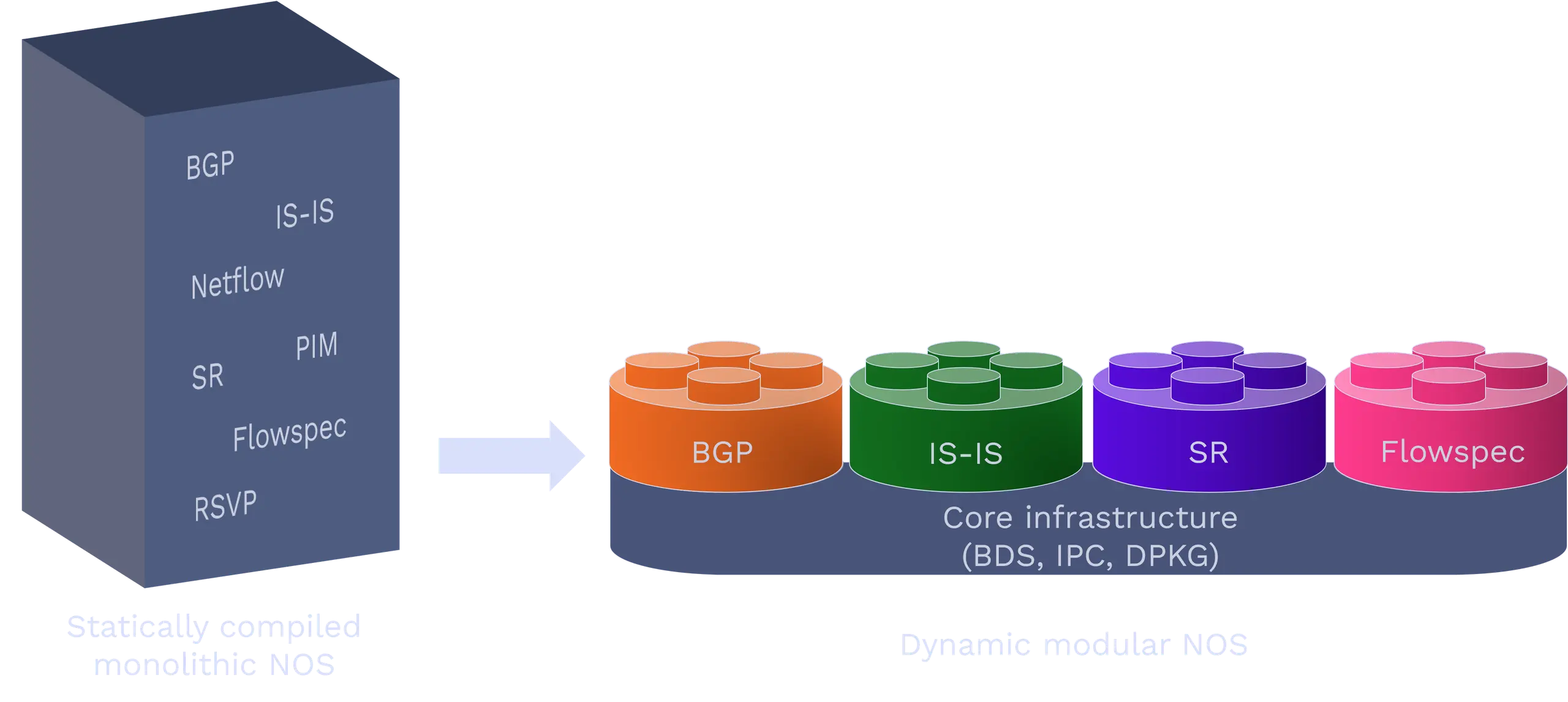
RtBrick uses time-hardened routing protocols to deliver resiliency and recovery, such as BGP, MPLS and IS-IS, all written in-house and run as independent microservices.
RtBrick uses time-hardened routing protocols to deliver resiliency and recovery, such as BGP, MPLS and IS-IS, all written in-house and run as independent microservices. Using a modern microservices architecture means:
- Each protocol or service runs independently
- Failures are isolated to specific components
- Individual services can restart without impacting the entire system
This also makes it far simpler, and faster, for RtBrick to test, isolate and fix any bugs in the routing software, as the microservices can be treated independently of one another, rather than the whole routing stack having to be treated as a single ‘black box’, with millions of lines of interdependent code to investigate and test. Stateful high availability allows IPoE subscribers to be re-established without them even noticing a failure. RtBrick can re-learn and repopulate a router’s FIB table faster than any other router available.
Features
The features* supported by RtBrick FullStack are expanding all the time, because it's much faster for us to add and test new features than it is using a traditional monolithic code base. You can find currently supported features by expanding the drop down list...
*may include some road-map features
Feature Table
- Routing Policy
- LDP
- L2X
- IPv4
- IPv6
- LU-v4
- LU-v6
- VPNv4
- VPNv6
- Add-path
- Multi-path
- Multi-hop
- Segment Routing
- 4-Byte AS
- IPv4
- IPv6
- Segment Routing
- OSPFv2 for IPv4
- OSPFv3 for IPv6
- Segment Routing
- VPP
- ACLs (IPv4/6, L2)
- QoS (policing, scheduling, queuing, hierarchical)
- RADIUS support
- PPPoE
- IPoE
- L2TPv2 (L3BSA)
- L2BSA - L2 Bitstream Access
- Accounting (Time/Volume based)
- Multicast - PIM-SSM, MVPN, IGMP v2/3
- Multicast - SSM Mapping
- RADIUS integration for subscriber channel policy
- Sub-second channel zap time
- Preview up to 15 other channels
- IPTV usage statistics
- CGNAT 444
- BGP Flowspec
- RPKI
- TCP-AO for BGP and LDP
- sFlow
- GTSM
- ResmondD
- CLI
- REST API
- RESTCONF
- SNMPv2C/v3
- ZTP Provisioning
The licensing model is structured into two perpetual elements and a support license
Per-Switch/Instance License
Perpetual, hardware-linked license based on the specific chipset (e.g., Broadcom Q2A vs. Q2C vs. Q2C+)
Network-Wide BNG/CGNAT License
Perpetual and migratable, based on aggregate subscriber count and the enabled feature set
Support and Upgrades Licenses
Required annual, 3-year, or 5-year terms for maintenance support and access to new functional releases.
Try it out for yourself – Download our software as a VM image.