

Management and APIs
- Manage by CLI
- Or use open consumer-driven APIs
- Prometheus database built-in
- Simple and scalable automation
- Extract highly granular data for optimum AI Ops
Consumer-Driven Management API
RtBrick’s Management API has been designed to simplify the integration with your existing OSS and BSS systems.
It reduces the amount of time and effort required to make your disaggregated network operational, and it leverages widely-adopted industry tools and programming languages. RtBrick’s API is ‘consumer-driven’ – which means you can use the formats and languages of your choice, rather than have them imposed on you by a vendor.
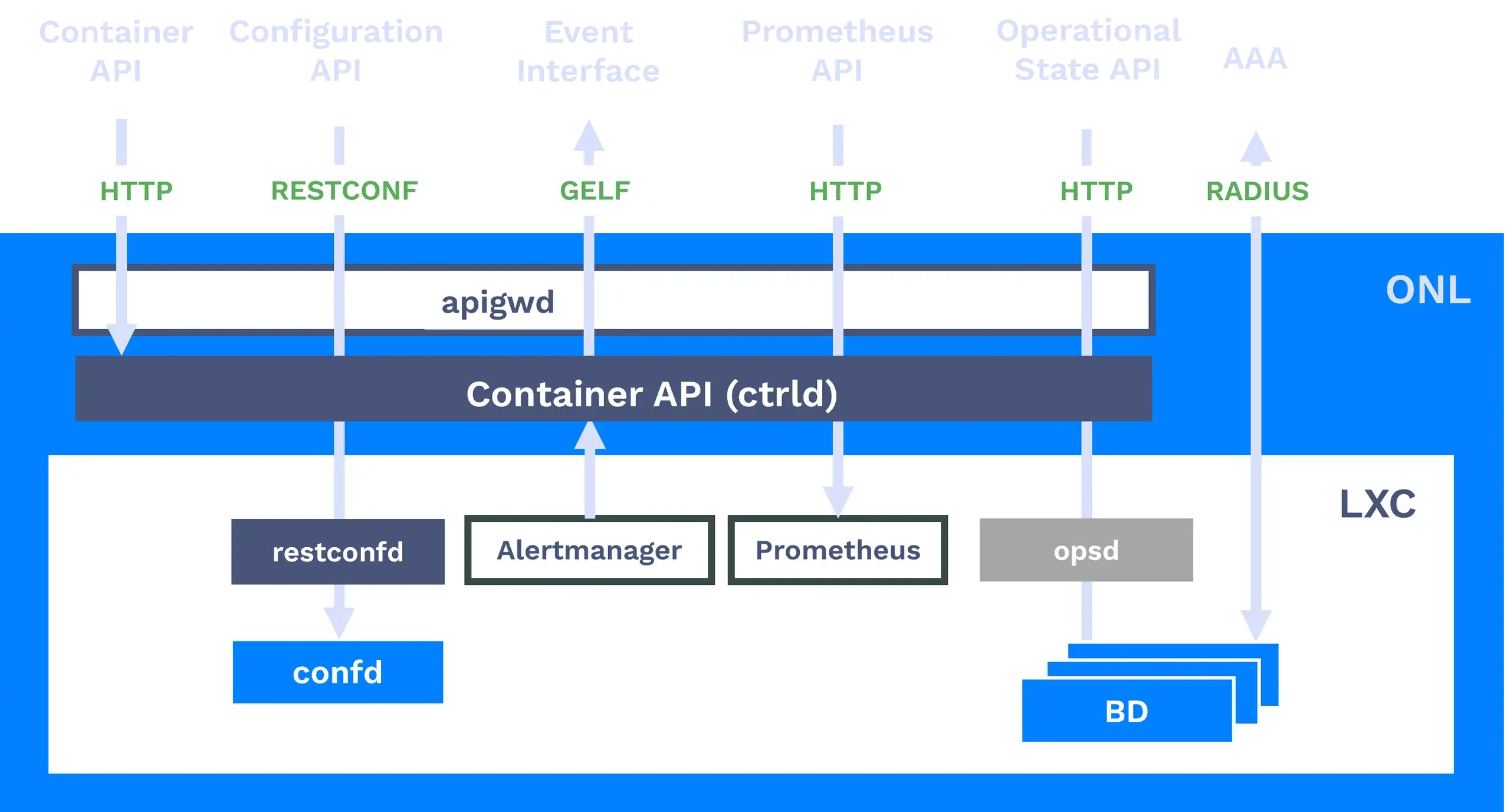
This allows you to build a client in Python, Go or Java, for example, as you prefer. And the APIs are all edited in Swagger, which is also a widely understood tool used by developers. RtBrick’s Management API actually comprises of several underlying APIs, which each follow the same consumer-driven approach.
Container API
The CONTAINER-API manages the lifecycle of the RtBrick routing software container. It is also an entry point into all the other APIs.
Configuration API
This RESTCONF API Manages persistent configurations in your network such as implementation of physical interfaces and HQoS in service designs, as well as ‘semi-persistent’ configurations such as enterprise services. The RtBrick Management API also generates ROBOT Framework key-words so you can automate REST-Conf testing.
Operational State API
This API manages state and is ideal for your day-to-day operations. It includes show commands and can manipulate states such ending a subscriber session, validating the state of optics or clearing to BGP peers or ISIS adjacencies.
Prometheus API
The PROMETHEUS API exposes all available metrics from the routing software and the underlying switch hardware in a standard format (Prometheus Exposition Format). These metrics can be used to send alert conditions, reminders and provide other essential operational intelligence.
Event Interface
This interface generates syslog messages, including additional attributes, so that they can be recorded in external systems.
RBFS Native API
Should it be needed, this API allows direct interaction with any attribute inside the RtBrick Data Store, which is a single database that includes everything from forwarding table information to the temperature of the chips in the underlying hardware. For ease of use the Operational State API abstracts this into a simpler to use layer.
Subscriber Management
Note that subscriber management is typically handled dynamically by RADIUS, which is our consumer-service BSS integration point.The APIs are described and published here.
Hear more about RtBrick's APIs and see them in action
We include a rich set of open web 2.0 tools so you can operate your network like a 'cloud-native', including:
- Prometheus – for monitoring and data storage
- Graylog – for log management
- Grafana – for visualization
Our API guide makes it easy for you to configure, manage, monitor, and automate RBFS deployments. It covers API architecture, authentication, CtrlD, RESTCONF and Operational State APIs, event-driven integrations, practical examples, and API references to help building strong integrations and simplify network operations.
Or if you want to dig a bit deeper you can see the actual APIs from the link below.
Try it out for yourself – Download our software as a VM image to experience the APIs for yourself

Our product range
BNG
- Your choice of open switch hardware
- Rich BNG feature set
- Integrated CGNAT
- High availability
- Scale up - or scale down

CGNAT
- Your choice of open hardware
- In-line CGNAT at full line-rate
- Standalone CGNAT or in the BNG
- Rich set of policy support
- Scale up - or scale down

Aggregation
- Your choice of open switch hardware
- Cost-effective
- Automate with open APIs
- Scale up - or scale down
- Part of your disaggregated multiservice edge

Peering
- Your choice of hardware
- Cost-effective
- Feature rich
- Scale up - or scale down
- Peering security

Data Center Interconnect
- Your choice of hardware
- Cost-effective
- Feature rich
- Simpler to automate
- Interconnect like a cloud-native