


BNG – Broadband Network Gateway Software
- Your choice of open switch hardware
- Rich BNG feature set
- Integrated CGNAT
- High availability
- Scale up - or scale down
Service Providers need mechanisms to authenticate and provision internet connectivity, and to bill customers. A BNG is the router that sits between the access and core networks of the operator to provide these functions.
RtBrick's BNG is a disaggregated, open software solution engineered to decouple carrier-grade networking functions from proprietary, closed hardware. Delivered as a high-performance Linux container (LXC) within a standard Linux environment, RBFS transforms 'bare-metal' switches into modular, highly automated network elements. By replacing rigid monolithic systems with a microservices-based architecture, RBFS enables a fundamental shift to 'Internet-native' operations, allowing carriers to scale access networks with the agility and cost-structures of global cloud providers.
RtBrick’s open BNG software delivers the following functions:
Subscriber Management
The BNG authenticates credentials, assigns IP addresses, provisions bandwidth, connectivity and other services, tracks active subscriber sessions. It works with the OSS/BSS systems in the customer's IT stack to provide usage data for billing purposes. It also manages the lifecycle of the active subscriber sessions from initiating the session to its termination.
Address Management and CGNAT
The BNG maintains pools of IP addresses and assigns them to subscribers on a need basis and recycling them upon termination of sessions, thereby ensuring efficient use of these expensive resources. BNGs provide the ability to provision IP addresses through policies - such as assigning specific public addresses to specific customers.
A BNG has to deal with 10s of 1000s of active subscribers and they further conserve IPv4 addresses by reusing the same IPv4 public address across a bunch of subscribers by deploying CGNAT services in tandem with the BNG frequently incorporating this function in the BNG itself.
Subscriber traffic policy and quality of experience
To keep the internet service cost effective, especially to residential subscribers, the BNG provisions the same ethernet bandwidth across multiple subscribers and yet retains subscriber experience by segmenting and giving differential treatment to subscriber traffic. The BNG provides sophisticated policy language to specify and provision this using Quality of Service.
Subscriber Security and Isolation
The BNG implements multiple levels of security such as anti-spoofing and isolation of subscribers by preventing them from intercepting each other's traffic
Meet Legal Requirements for Hosting Subscribers
The BNG enables support for requirements to provide service parameters and tap subscriber traffic in response to Law enforcement requests. These are legal requirements that the service provider needs to fulfil that are met through the BNG.
Wholesale Services
In many markets, subscribers are bundled together and sold to retail customers who then provide subscriber termination and other services to these subscribers. The provider who does the bundling is providing the wholesaling service to the retail customers. A BNG is used to provide both wholesale and whole-buy services and implementation of the contracts on the aggregate traffic.
Different Approaches to Building a BNG
There are a number of different ways to create a BNG, from legacy monolithic systems to modern software-based systems.
- Monolithic - proprietary chassis-based systems. Expensive line-cards, hard to scale-down and leaving you hostage to vendor lock-in
- Virtualized solution - x86 based with shared resources for control and forwarding planes. Power hungry with poor QoS support. Acceptable at very low-scale
- CUPS - driven by mobile architectures with the control plane operating in the cloud. Unproven at scale with huge blast radius risk from centralized control plane. Complex and expensive
- Disaggregated BNG - open software running on open switches. The RtBrick approach
RtBrick uses a modern disaggregated approach, separating open switch hardware from the software running on it. It uses proven routing protocols with high availability features and distributes the control plane around the network to reduce risk.
Read more about the alternative approaches.
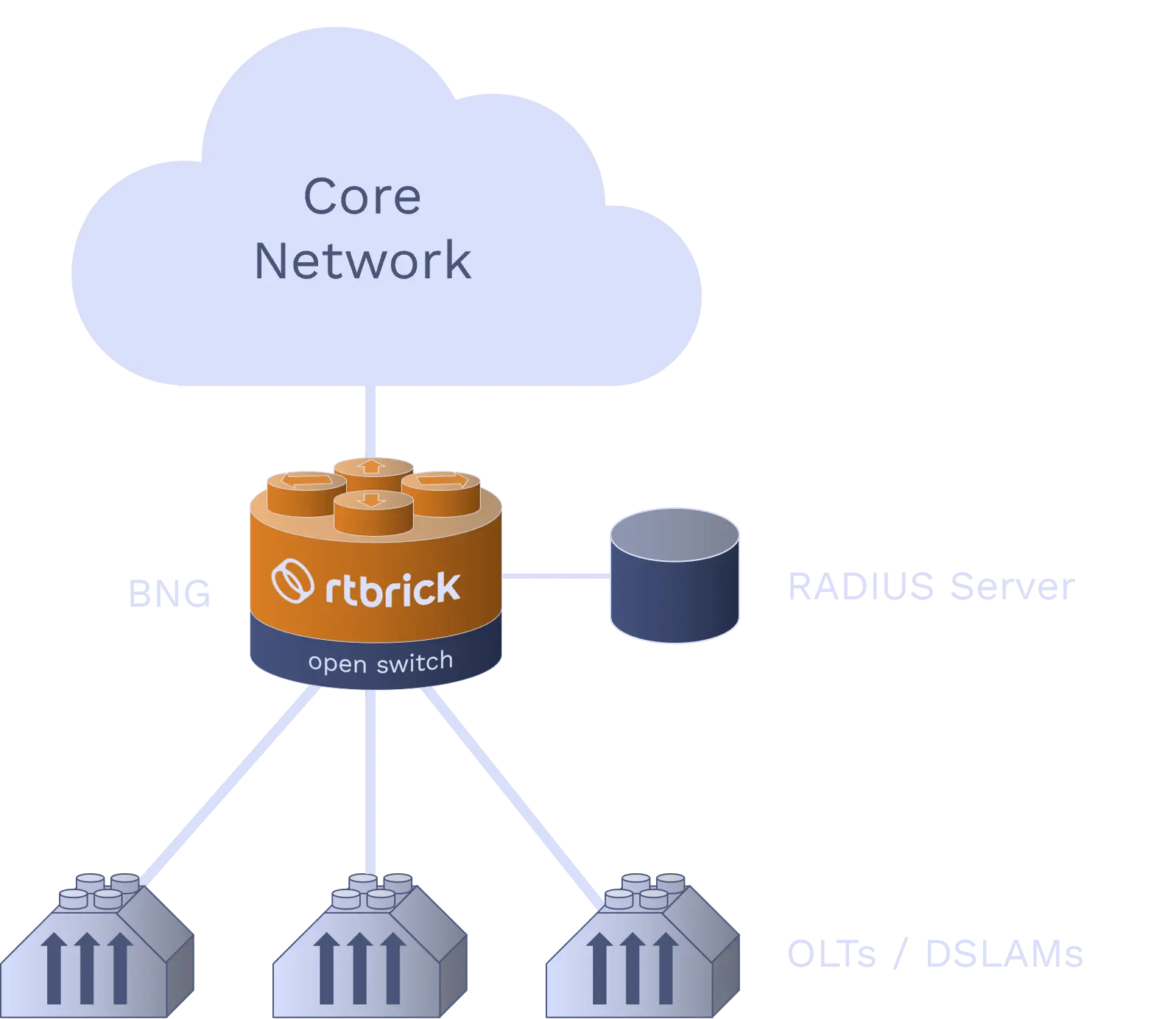
RtBrick's BNG Solution
RtBrick's BNG is based on a disaggregated approach. It uses 1RU/2RU OCP compliant switches built by ODMs using merchant silicon from Broadcom. The solution unlocks multiple network functions in this role when overlaid with RtBrick's NoS, RtBrick Full Stack (RBFS). In spite of following a disaggregated approach, RtBrick takes full maintenance and support responsibility for the combined network nodes thereby enabling customers to deal with a single entity for support services.
The approach of combining hardware and software from different vendors enables the customer to break out of vendor lock-in situations. Moreover, merchant silicon-based solutions offer significant cost optimization, both in terms of capex and also opex through low power consumption (0.5W/Gbps). Further, each device can unlock up to 3 network functions simultaneously (BNG, CGNAT, full table IP/MPLS router) and enable collapsing multiple hardware devices into one.
The devices themselves are 'pizza box' switches that can be combined with other devices using standards-based protocols thereby avoiding forklift upgrades and upgrade of one device does not cascade into more upgrades in the network.
This solution brings the benefits of the CUPS approach without the attendant disadvantages. As these devices have a small form factor, and can even be temperature hardened, means that they encourage a distributed deployment. This reduces the blast radius to decrease risks. Since the devices retain the control plane, they do not place stringent communication requirements on the network like a CUPS deployment.
Additionally, integration of a Prometheus database in each switch enables efficient storage and access to thousands of metrics at granularity not provided by legacy approaches, such as SNMP. These can be integrated with open-source tools to build customer dashboards which provide unrestricted visibility into the system as well as the ability to federate this data for a centralized analysis across multiple AI-ops systems.
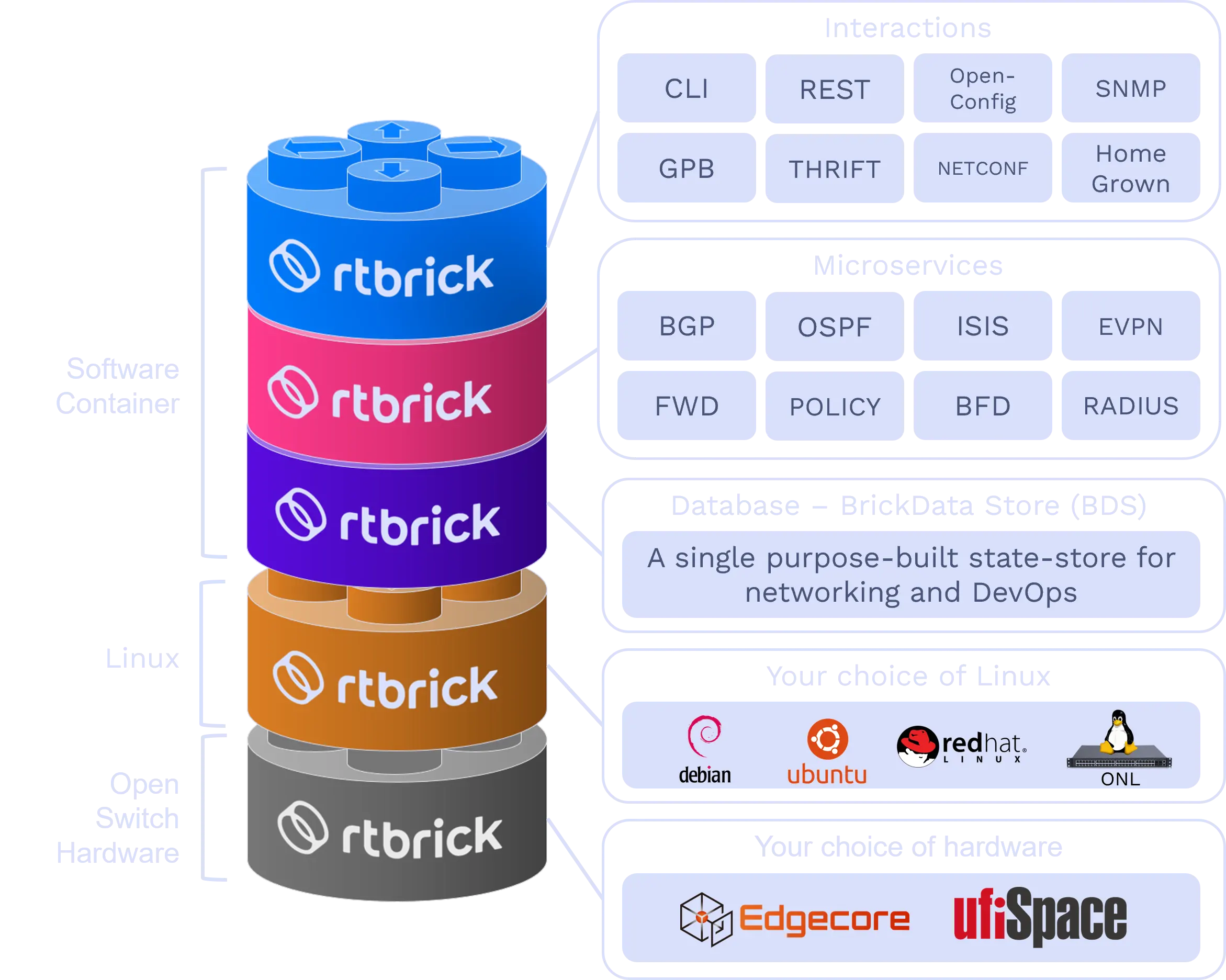
Our Consumer-Driven Management APIs have been designed to simplify the integration with your existing OSS and BSS systems.
Try it out for yourself – Download our software as a VM image.

Our other solutions
CGNAT
- Your choice of open hardware
- In-line CGNAT at full line-rate
- Standalone CGNAT or in the BNG
- Rich set of policy support
- Scale up - or scale down

Aggregation
- Your choice of open switch hardware
- Cost-effective
- Automate with open APIs
- Scale up - or scale down
- Part of your disaggregated multiservice edge

Peering
- Your choice of hardware
- Cost-effective
- Feature rich
- Scale up - or scale down
- Peering security

Data Center Interconnect
- Your choice of hardware
- Cost-effective
- Feature rich
- Simpler to automate
- Interconnect like a cloud-native