Link Layer Discovery Protocol (LLDP)
Overview
Link Layer Discovery Protocol (LLDP), defined in IEEE 802.1AB, is a vendor-neutral Layer 2 protocol that enables network devices to advertise their identity, capabilities, and configuration information to directly connected neighbors on an Ethernet network.
LLDP operates at the data-link layer and is independent of the network-layer protocol. Therefore, devices can exchange discovery information without requiring Layer 3 connectivity or routing to be configured.
LLDP-enabled devices periodically transmit LLDP frames through their interfaces. The frames contain information about the local device and interface, which neighboring devices use to identify and characterize the connected device.
LLDP information is exchanged using Type-Length-Value (TLV) elements. Each TLV specifies a type, length, and value and carries a specific piece of information about the device or interface.
Common information advertised through LLDP includes:
-
System identity: Device name and system description.
-
Port identity: Identifier of the local interface.
-
Management address: Address used for management access.
-
System capabilities: Capabilities supported by the device, such as router, bridge, WLAN access point, or host.
-
Interface and configuration information: Additional information associated with the local interface and network configuration.
By providing a standardized mechanism for exchanging this information, LLDP enables devices from different vendors to automatically discover directly connected neighbors and their capabilities.
LLDP Packet Processing
All LLDP packets are sent to the CPU for processing and are assigned a lower priority than routing protocol packets. During network congestion, LLDP packets may be subject to policing.
LLDP Interactions with Other Microservices
RBFS consists of several microservices that run as background processes. LLDP interacts with these services to access the required configuration information.
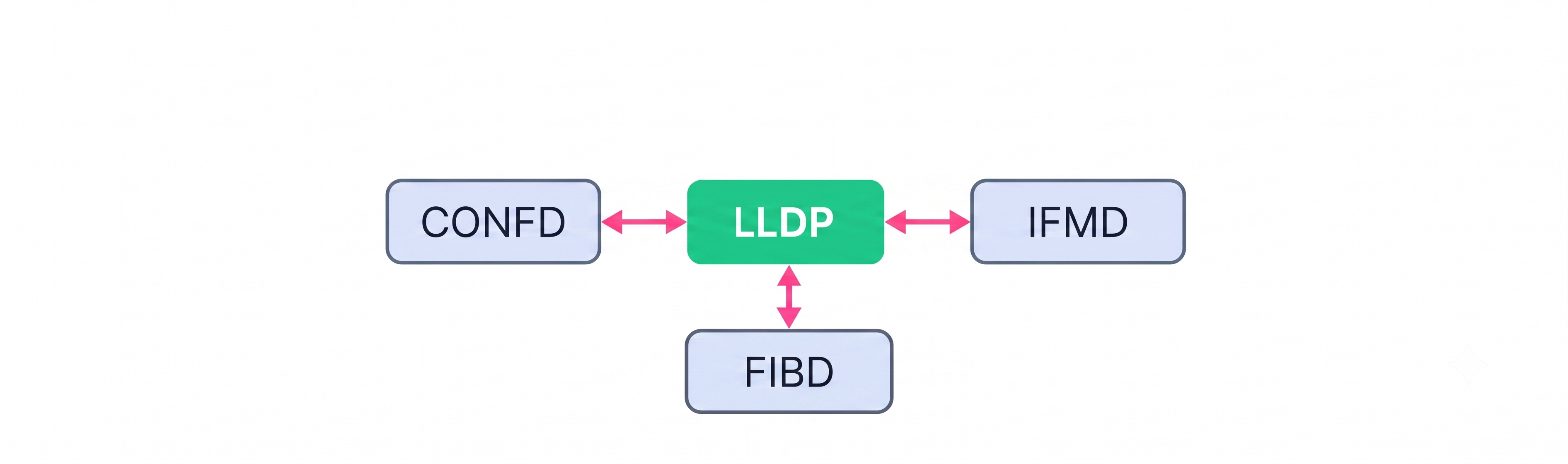
The following table describes the interactions between LLDP and other RBFS microservices.
| Microservice Name | Microservice Description | Interaction Details |
|---|---|---|
CONFD |
Configuration |
CONFD stores all LLDP configuration data. |
IFMD |
Interface Monitoring |
LLDP is enabled on physical interfaces and subscribes to the IFP table to monitor their link status. LLDP messages are transmitted only on interfaces whose link state is UP. |
FIBD |
Forwarding Information Base |
FIBD subscribes to the LLDP interface table, which contains all parameters required to enable LLDP on an interface and program it into VPP. When VPP detects a neighbor, it sends a notification that FIBD logs in its tracking table. FIBD updates this record with every incoming message from the neighbor, maintaining a full message history. LLDP then subscribes to this FIBD table to discover and track its neighbors. |
Default Inclusion of System Description TLV in LLDP
The System Description TLV is included in LLDP packets and contains details about the RBFS software, its version, and hardware platform.
LLDP Limitations
The following are the limitation of LLDP.
-
LLDP is not supported on bundle interfaces.
-
LLDP is disabled on the physical interfaces on Q2C-based platforms and LAG member interfaces of UfiSpace S9500-22XST platform.
LLDP Limitations with L2 Cross-Connect (L2X)
LLDP is disabled when an interface is configured in any of the following L2X scenarios:
-
As the outgoing interface in egress L2X.
-
As the outgoing interface in ingress L2X with a match type of
anyoruntagged. -
As either the outgoing or incoming interface in a bidirectional L2X configuration.